From the stacks
Introducing Meletema
Adaptive flashcards that live inside your LMS, with grades that reflect what a student actually knows. Here is what we built and why.
μελέτημα — a practice-piece; a thing studied until it is yours.
Flashcards are old, effective, and slightly unfashionable. Retrieval practice — being asked and having to produce the answer — is one of the better-evidenced findings in learning research, and it has survived every wave of educational technology that was going to replace it.
The tools, though. The good flashcard apps are consumer products: advertising-supported, account-required, data-hungry, and entirely separate from the course. An instructor who wants students practicing terminology ends up telling thirty people to sign up for something, then has no idea whether any of them did.
Meletema is our attempt at the version that belongs in a course.
It lives in the LMS
Meletema is an LTI tool. Instructors add it to a course in Canvas, Moodle, Blackboard, or anything else that speaks the standard, and students click through from the course itself.
No separate account. No roster to upload or maintain. No first-week support burden of students who cannot log in to a thing that is not the LMS. The LMS already knows who they are, and Meletema trusts it.
We support LTI 1.1 and 1.3, plus dynamic registration — paste one URL and you are connected. We support the older version too, because plenty of institutions are running an LMS release where 1.3 registration means a conversation with central IT that could take a semester.
Cards that pay attention
Each card carries its own mastery score. Cards a student misses come back; cards they have demonstrably learned stop taking up their time.
The format adapts as well — flip cards and multiple choice, chosen automatically based on where the student is with that particular card. Recognition is easier than recall, and a good practice session moves from one to the other rather than sitting in whichever mode the deck was authored in.
The design goal was for a student to spend their time on the cards they do not know. That sounds obvious. A surprising number of tools still march everyone through the full deck in order, every time.
Grades that mean something
Final scores post back to your gradebook over AGS or Basic Outcomes, depending on your LTI version. Signed, queued, and retried until they land.
The more interesting decision is what gets scored. Meletema grades on demonstrated proficiency across the deck — did the student actually learn these cards — rather than on time spent or attempts made. A student who knows the material and finishes quickly should not be penalized, and a student who clicks through the same session eleven times should not be rewarded for it.
That is a defensible number to put in a gradebook, which is more than can be said for participation metrics dressed up as achievement.
Decks you can share
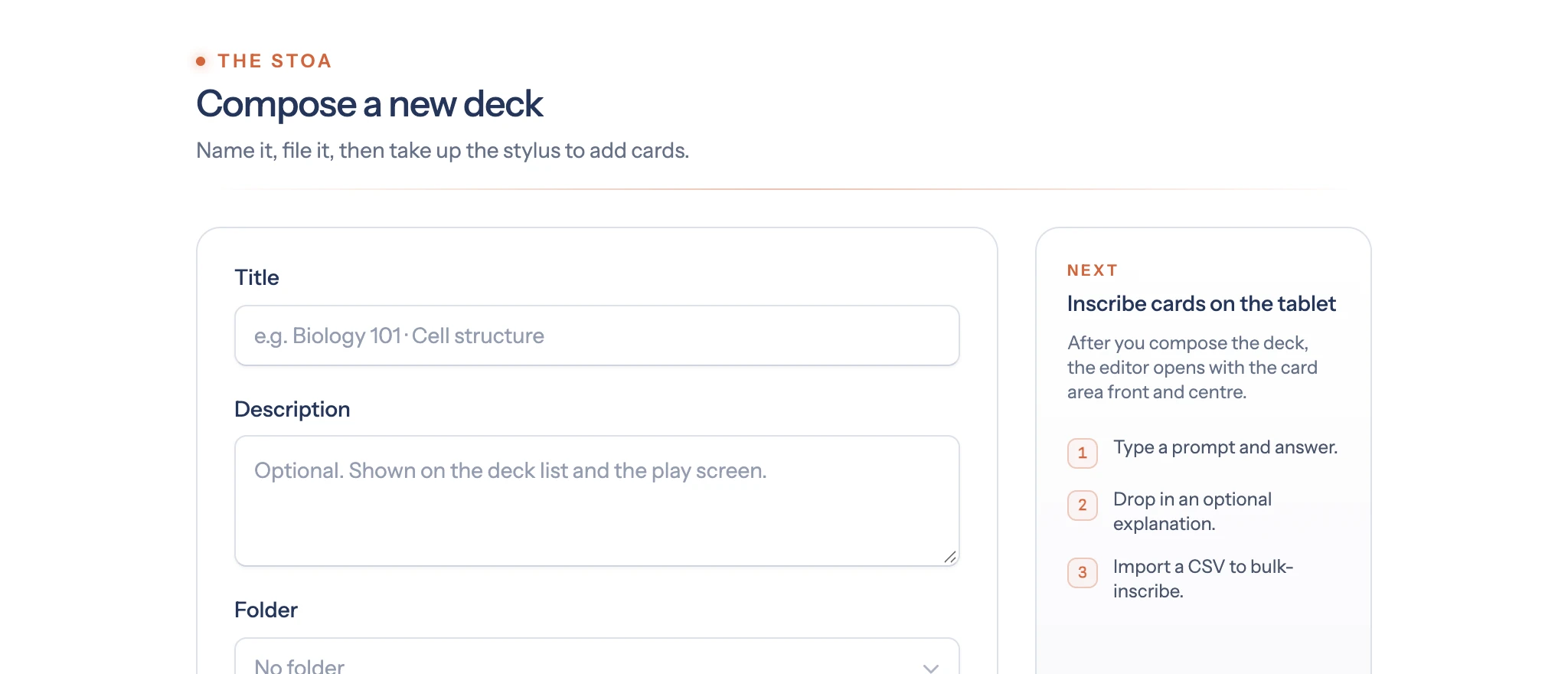
Instructors compose decks in a plain editor: prompts, answers, folders, tags, search. Nothing exotic.
The part that matters for departments is per-organization sharing. Build the anatomy terminology deck once, share it with colleagues teaching the same course, reuse it next term. Every institution we talked to during development had at least one instructor maintaining a deck privately that four other people would have used.
What we are not doing
Worth saying explicitly, because the category has a reputation.
No advertising. Not in the free tier, not anywhere. A tool a student is required to use for a grade is not an appropriate place to sell them things.
No data harvesting. We ask the LMS for the minimum needed to run the activity and report the grade. We do not build profiles, and we do not sell anything to anyone.
No student accounts. There is nothing for a student to sign up for, which means there is nothing for them to be marketed to through later.
These are not features so much as the absence of anti-features. But if you have evaluated study tools recently, you know why they need saying.
Three steps
Connect your LMS — generate a registration URL or LTI 1.1 credentials, paste them in, done. Compose a deck. Assign it, and grades flow back.
Realistically that is an afternoon for a first deck, less once you have done it.
Try it
There is a free trial and it does not ask for a credit card. Compose a deck, drop it into a course, and see how it feels from the student side — which we would encourage, because the student view is the one that matters and it is the one instructors rarely look at.
If you want to talk through whether it fits a particular course, get in touch. And if you are evaluating LTI tools generally, our checklist from a couple of months back applies to us as much as to anyone else. Hold us to it.